The Santal Creation Story: Kolean Guru’s Ancient Narrative of Thakur-Jiu and the First Humans
In the Beginning: A World of Water
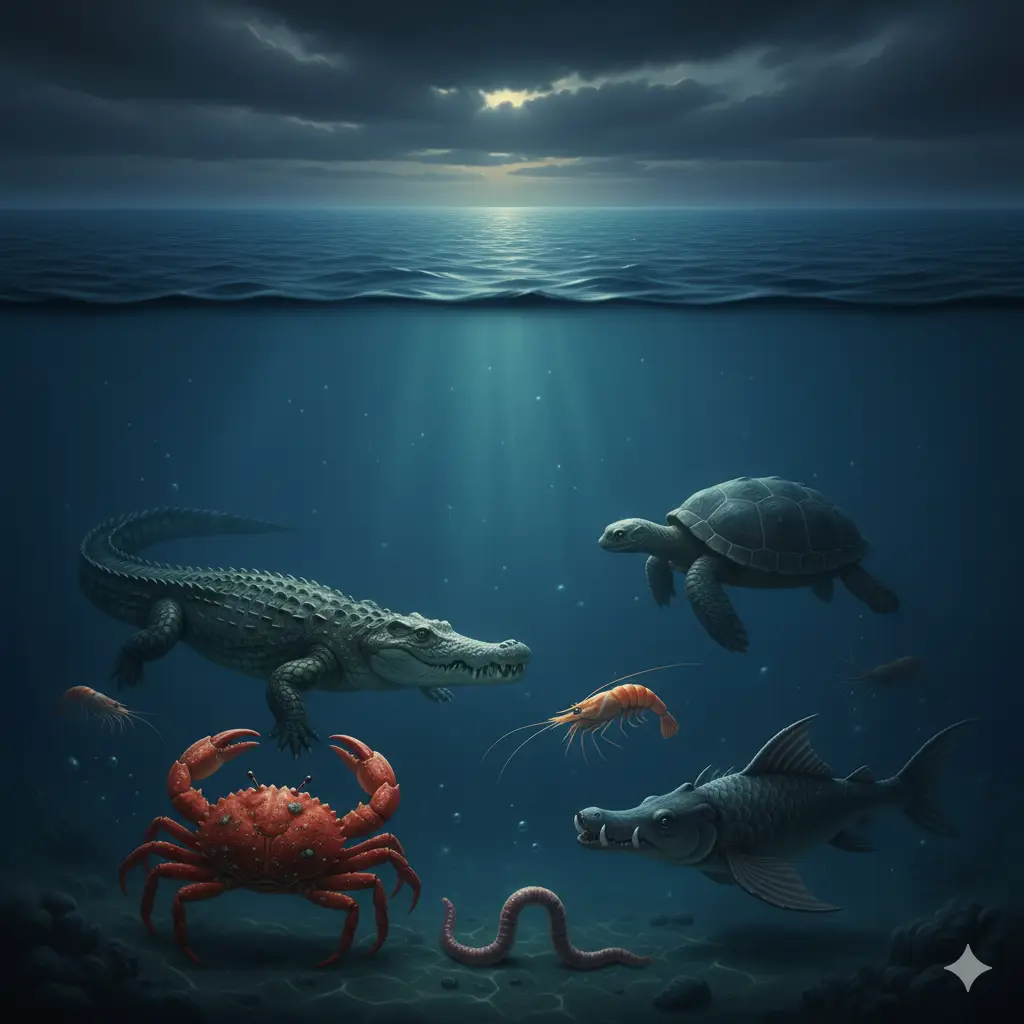
The oldest Santal traditions begin with a scene of utter solitude. There was no land, no forest, and no living creature. There was only a vast, dark expanse of water.
In this primal ocean, the Supreme God, Thakur—the source of life—first created the water dwellers. The first beings to draw breath were the Alligator and the mighty Crocodile. They were soon joined by the Crab, the Prawn, the Earthworm, and the Tortoise. Thakur also fashioned the unusual Raghop Boar fish, a creature that swam deep in the water. This was the first world, a place of silent, boundless water.
The Difficult Birth of the Earth
Thakur then announced his greatest intention: to “make man.” But man could not live in the endless water. Solid earth was needed.
Thakur first tried to create two great earth-bearers to hold up the land. But these new beings were impatient. They grew restless waiting for their souls, and in their haste, they fell from above, were crushed, and dissolved into the water. The attempt failed.
Thakur turned his gaze to the creatures of the deep. He asked the Alligator and the Crab to bring up the earth, but the moment they reached the surface, the mud dissolved in the water. The Raghop Boar tried, biting at the earth, but the soil turned to nothing in his mouth. The Earthworm, unable to stand on the water, could not complete the task.
The Triumph of the Tortoise
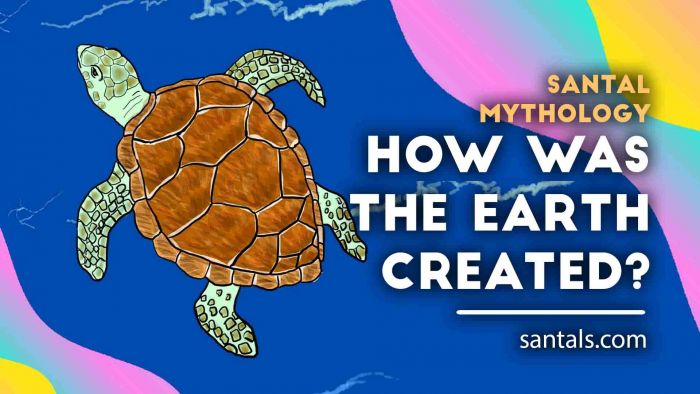
Finally, Thakur called upon the Tortoise (Kạchịm). The Tortoise humbly agreed, saying, “If you tell me to do so, I might stand.”
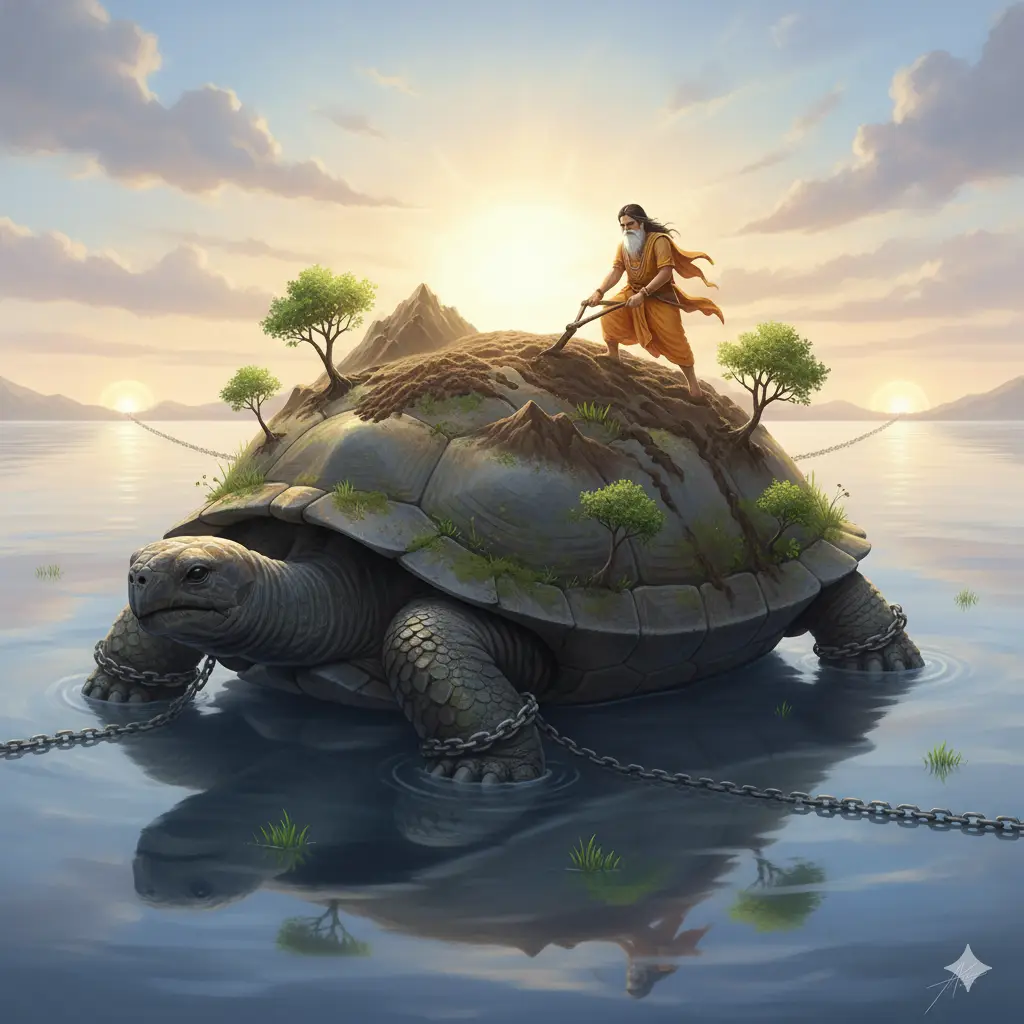
Thakur worked quickly. He secured the Tortoise’s four legs, chaining him to the four points of the horizon. Then, the Tortoise stood on water, silent and steady. Then the earthworm went down to bring up the earth; he had put his tail on the back of the tortoise, and with his mouth scooped up earth and brought it out of his tail on the back of the tortoise. He then spread the mud across his sturdy back, forming a thin, hard film: the earth.
Thakur began the work of shaping the world. He started to plough and harrow the surface, intending to make it flat and smooth. But his continuous effort only pushed the earth up, making it uneven and rugged. That is how the great mountains were formed. Once the land was ready, Thakur sowed the sirọm seed. The sirọm grass sprang up first, followed by dhubi grass and the great trees: the karam tree, the tope sạrjọm, the labar atnak and so on. The earth was now covered with life and was beautiful.
The First Humans and Their Innocence
The stage was set for mankind. Thakur had created two majestic birds, the Hãs & Hãsil, and they flew down to the new earth. They settled on the delicate sirọm grass and built their nest.
The Hãs Hãsil birds laid two eggs. From these two eggs, a boy and a girl hatched. These were the first human beings, the ancestors of the Santal people.
The birds became distressed. They cried out to Thakur, “How shall we two support these two tiny human beings?”
Thakur provided for them. He took cotton, squeezed its juice, and put this divine mixture into the children’s mouths. Nourished by this substance, the first humans grew quickly.
They were named: Pilcu Harạm (the First Male) and Pilcu Buḍhi (the First Female). They lived in the Hihiri-Pipiri country. They ate the grains of the sumțu bukuć grass and the ears of the sạma grass. They were innocent, walked naked, knew no shame, and lived in perfect peace.
The Fall, the Beer, and the Shame
This peaceful existence was soon to be tested. The powerful Marạń buru, the principal spirit of the Santals, came to them. He showed the ancestors how to prepare the fermentation materials and brew beer (pachwai).
They took rice, pounded it, mixed it with the fermenting medicine, and let it sit. Thereupon, they made three leaf-cups; poured one cup on the ground in the name of Marạń buru. When they drank the resulting beverage, they became instantly intoxicated.
Thakur, seeing this new development, came down to visit. The ancestors, now drunk, were overcome with shame and tried to hide, covering themselves with leaves. Thakur merely laughed, saying, “It does not matter,” and allowed them to continue covering themselves. This incident marks the loss of their primal innocence.
Also Read: Santal Folklore: The Story of Dayans and Ojhas
The Great Deluge
Pilcu Harạm and Pilcu Buḍhi grew old and fruitful. They had seven sons and seven daughters, who followed the first custom: the eldest son married the eldest girl, and so on down the line.
As mankind multiplied, they became increasingly wicked and proud. They forgot the goodness of Thakur and became disrespectful. In his great anger, Thakur decided to destroy the corrupted world.
He called the original pair, Pilcu Harạm and Pilcu Buḍhi, and gave them a divine warning: “You two go into the cave in the Harata mountain; there you two will be saved.”
They found the shelter as commanded. Then, rain streamed from the sky for seven days and seven nights. The great deluge wiped out every human, every animal, and every trace of civilisation. Except for the ones who obeyed Thakur and took shelter in the mountains.
The New Dawn and the Twelve Septs
When the storm finally cleared, the old pair emerged. All they could find of the previous world was destroyed. They climbed a mountain and settled on a large plain called Sasạń Beḍa.
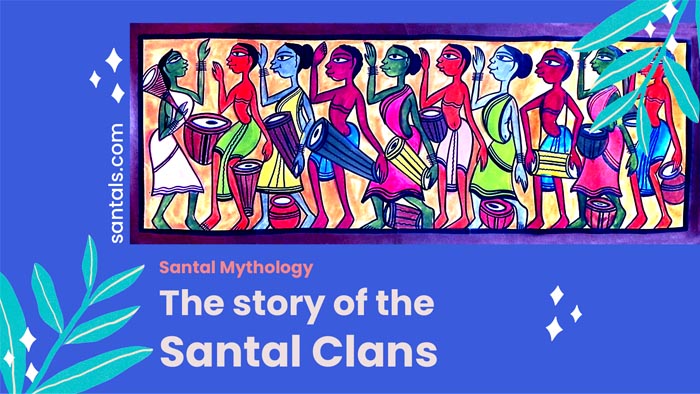
Here, they established the foundation of the Santal nation. They remembered the original septs (clans) of their ancestors and divided their descendants into twelve septs (clans):
- Hasdak
- Murmu
- Kisku
- Hembrom
- Marandi
- Soren
- Tudu
- Baske
- Besra
- Pauria
- Core
- Bedeạ (lost sept)
The Great Journey to Cae Campa
From Sasạń Beḍa, the Santals began a long series of migrations. Overpopulation and conflicts with the forest spirits drove them onward. They passed through the Jạrpi country and lived for a time in Bāih Duạr before moving to the Kạeṇḍe country.
Their final, golden settlement was Cae Campa. Here, the Santal ancestors built massive forts to protect their growing civilisation. Each of the ruling septs established a fortress: Kịsku built the Koenda Fort, Murmu built the Campa Fort, and so on.
Cae Campa was the age of law and order. The traditional roles of the septs were cemented: the Kịsku were the kings and rulers; the Murmu were the priests; the sorens were peons & fighters; the Hembrom were the respected nobility; Marandis were wealthy class; Baske were merchants, and the Tuḍu became musicians & iron workers. It was here they established the custom of worshipping Marạń buru and the Jạhēr erạ (Lady of the Sacred Grove).
The End of an Era
The peace in Campa was shattered by war. The Santals, after a long conflict with the Deko people, were eventually vanquished. They lost the great Campa fort and were forced to migrate eastward toward the Ganges river, fighting the Dekos and later the Muslims.
During these long migrations and conflicts, the Santals began to forget some of their own strict customs and adopted some new ways from the Hindus. The story ends with a poignant reflection: the Santals now live under the influence of others, their original land rights are lost, and their traditions, while still strong, are preserved only orally—”all in the mouth.”
The story of Kolean Guru, written down in 1871, serves as the most vital memory of their glorious origins, their laws, and the sacred history of the Santal people.
Subscribe to our newsletter!